
Menu
Challenge
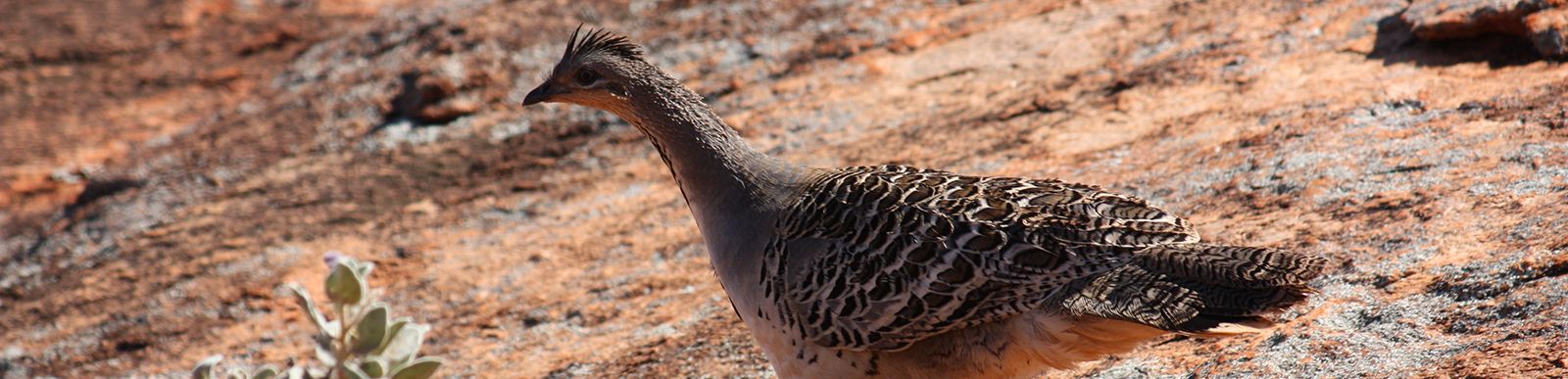
The Malleefowl (Leipoa ocellata) inhabits semi-arid mallee scrub, requiring abundant leaf litter for its remarkable nesting mounds. As one of only three mound-building birds in Australia and the sole species adapted to arid zones. Malleefowl uses decomposing vegetation to incubate eggs, a sophisticated system unmatched among birds. Listed as Vulnerable under the EPBC Act, Malleefowl populations in the southern rangelands face habitat degradation from large feral herbivores, predators and inappropriate fire regimes. “Built for extremes, but increasingly pushed beyond them.
The Malleefowl (Leipoa ocellata) relies on a finely balanced system: semi-arid to arid shrublands and mallee landscapes with abundant leaf litter to construct and regulate its incubation mounds. This rare strategy – using decomposing vegetation to control the incubation temperature of their eggs — is so specialised that even small disruptions can disrupt this balance and reduce breeding success.
That balance is now under strain.
• Inappropriate fire regimes are degrading Malleefowl habitat and suppressing breeding activity by removing critical leaf litter and mature vegetation structure.
• Invasive ‘weedy’ species are displacing native flora and increasing fuel loads, intensifying bushfires and compounding habitat loss.
• Feral predators, including foxes and feral cats, are directly limiting Malleefowl populations through predation on eggs, chicks and adults, placing sustained pressure on already vulnerable populations.
Large feral herbivores (LFHs), including camels and donkeys, are causing widespread habitat degradation across the southern rangelands by trampling nesting mounds, heavily grazing native vegetation, and reducing water quality and availability.
Solution
Rangelands NRM is delivering a coordinated threatened species recovery project focused on protecting Malleefowl across the WA Southern Rangelands. The project supports First Nations land managers to lead and participate in conservation activities that improve knowledge, monitoring and management of Malleefowl habitat.
The work includes identifying and prioritising potential Malleefowl sites, synthesising existing baseline data, conducting Malleefowl fauna surveys, undertaking skills and knowledge surveys, supporting stakeholder engagement events and implementing large feral herbivore control across priority areas. The project specifically targets large feral herbivores such as camels, horses and donkeys, which can damage vegetation, reduce habitat quality and place pressure on remaining Malleefowl populations.
The project also recognises that Malleefowl conservation requires both ecological science and cultural knowledge. First Nations partners are central to the design and delivery of monitoring approaches, helping ensure survey methods are culturally appropriate, locally informed and useful for ongoing management of Country.
Impact
This project will support the long-term recovery of Malleefowl by improving knowledge of where the species occurs, reducing habitat pressures and strengthening First Nations leadership in threatened species conservation.
By combining ecological monitoring, cultural knowledge, pest animal control and partnership-based delivery, the project contributes to healthier landscapes, stronger ranger capability and more sustained conservation action across the WA Southern Rangelands.
Outcome
By 2028, the project will strengthen Malleefowl recovery by supporting First Nations groups and collaborations to build skills, gather knowledge and lead culturally relevant survey work across the Goldfields and Southern Rangelands.
The project will also reduce large feral herbivore pressure across priority Malleefowl habitat, helping improve the condition of vegetation and habitat that supports future Malleefowl conservation.
Get in touch
Fill in the below form and we'll get you to the right place.
Recent Projects