
Challenge
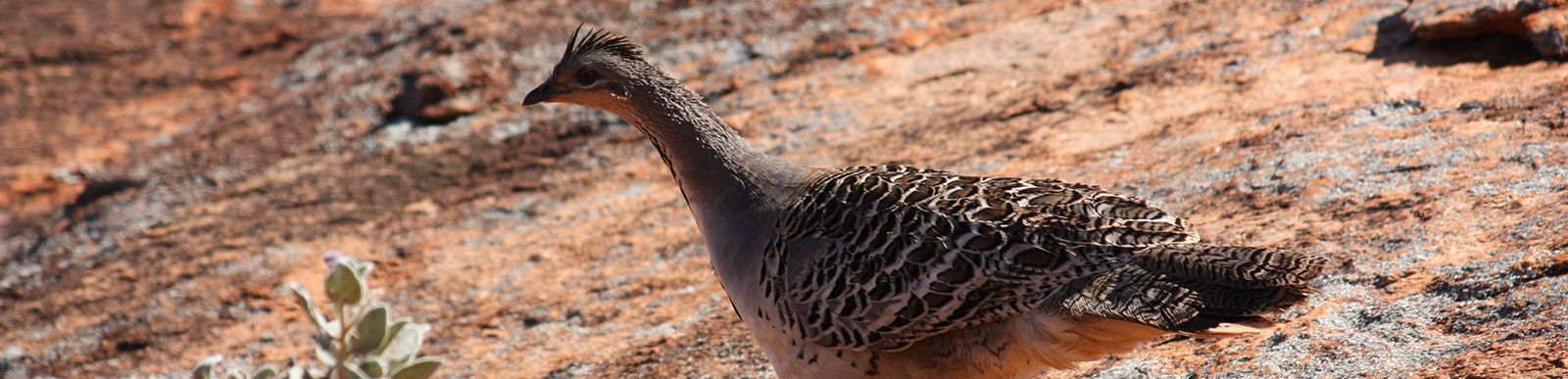
The Malleefowl (Leipoa ocellata) inhabits semi-arid mallee scrub, requiring abundant leaf litter for its remarkable nesting mounds. As one of only three mound-building birds in Australia and the sole species adapted to arid zones. Malleefowl uses decomposing vegetation to incubate eggs, a sophisticated system unmatched among birds. Listed as Vulnerable under the EPBC Act, Malleefowl populations in the southern rangelands face habitat degradation from large feral herbivores, predators and inappropriate fire regimes. “Built for extremes, but increasingly pushed beyond them.
The Malleefowl (Leipoa ocellata) relies on a finely balanced system: semi-arid to arid shrublands and mallee landscapes with abundant leaf litter to construct and regulate its incubation mounds. This rare strategy – using decomposing vegetation to control the incubation temperature of their eggs — is so specialised that even small disruptions can disrupt this balance and reduce breeding success.
That balance is now under strain.
• Inappropriate fire regimes are degrading Malleefowl habitat and suppressing breeding activity by removing critical leaf litter and mature vegetation structure.
• Invasive ‘weedy’ species are displacing native flora and increasing fuel loads, intensifying bushfires and compounding habitat loss.
• Feral predators, including foxes and feral cats, are directly limiting Malleefowl populations through predation on eggs, chicks and adults, placing sustained pressure on already vulnerable populations.
Large feral herbivores (LFHs), including camels and donkeys, are causing widespread habitat degradation across the southern rangelands by trampling nesting mounds, heavily grazing native vegetation, and reducing water quality and availability.
Solution
Rangelands NRM works across the southern rangelands to protect and restore Malleefowl habitat through a three-pathway approach: monitoring populations and habitat condition across priority areas to guide targeted interventions; controlling large feral herbivores, predators and invasive weeds while managing fire to maintain patchy landscapes that protect nesting mounds; and supporting Indigenous rangers to lead land management activities on Country using Traditional Ecological Knowledge.
Impact
Established surveys of malleefowl mounds and collaborating in partnerships; program initiating LFH control and monitoring to track mound activity and vegetation condition and health over 2024–2028. “Impact
Protecting habitat, strengthening Country, and building long-term resilience
Targeted action across the southern rangelands is delivering tangible benefits for Malleefowl and the landscapes they depend on, while strengthening the systems needed for long-term conservation success.
Healthier habitat and improved breeding conditions
Integrated fire, weed and pest management is reducing pressure on key breeding areas, helping protect leaf litter, nesting mounds and long-unburnt vegetation essential for successful incubation. Ongoing monitoring is improving understanding of breeding activity and habitat condition over time.
Reduced cumulative pressure across landscapes
Managing large feral herbivores, invasive weeds and feral predators is helping to address habitat degradation caused by grazing, trampling and altered fire behaviour. This approach supports vegetation recovery, improves water availability, and reduces risk to remaining Malleefowl populations.
Stronger, place-based land stewardship
Supporting Indigenous rangers to lead monitoring, fire management and feral animal control is reconnecting Traditional Ecological Knowledge with contemporary conservation practice. This approach strengthens cultural land management, builds local capability, and delivers outcomes that are grounded in Country.
Better information, better decisions
Malleefowl mound surveys and habitat assessments are contributing to the National Malleefowl Monitoring Database, strengthening regional and national understanding of population trends and guiding future conservation effort.
What this work has shown
Experience across diverse desert environments has reinforced three key lessons:
• Effective Malleefowl conservation requires addressing interacting threats, not single issues.
• Cultural knowledge and ecological science together produce stronger land management outcomes than either alone.
Local leadership and continuity are essential for lasting impact beyond individual projects.
Outcome
The Malleefowl Recovery Program is delivering tangible outcomes for one of Australia’s most specialised birds and the landscapes they depend on. By combining targeted on-ground management with Indigenous leadership and scientific monitoring, the program is building the long-term conservation infrastructure needed to stabilise and recover Malleefowl populations across the southern rangelands, while strengthening the ecological health and resilience of the broader landscape.